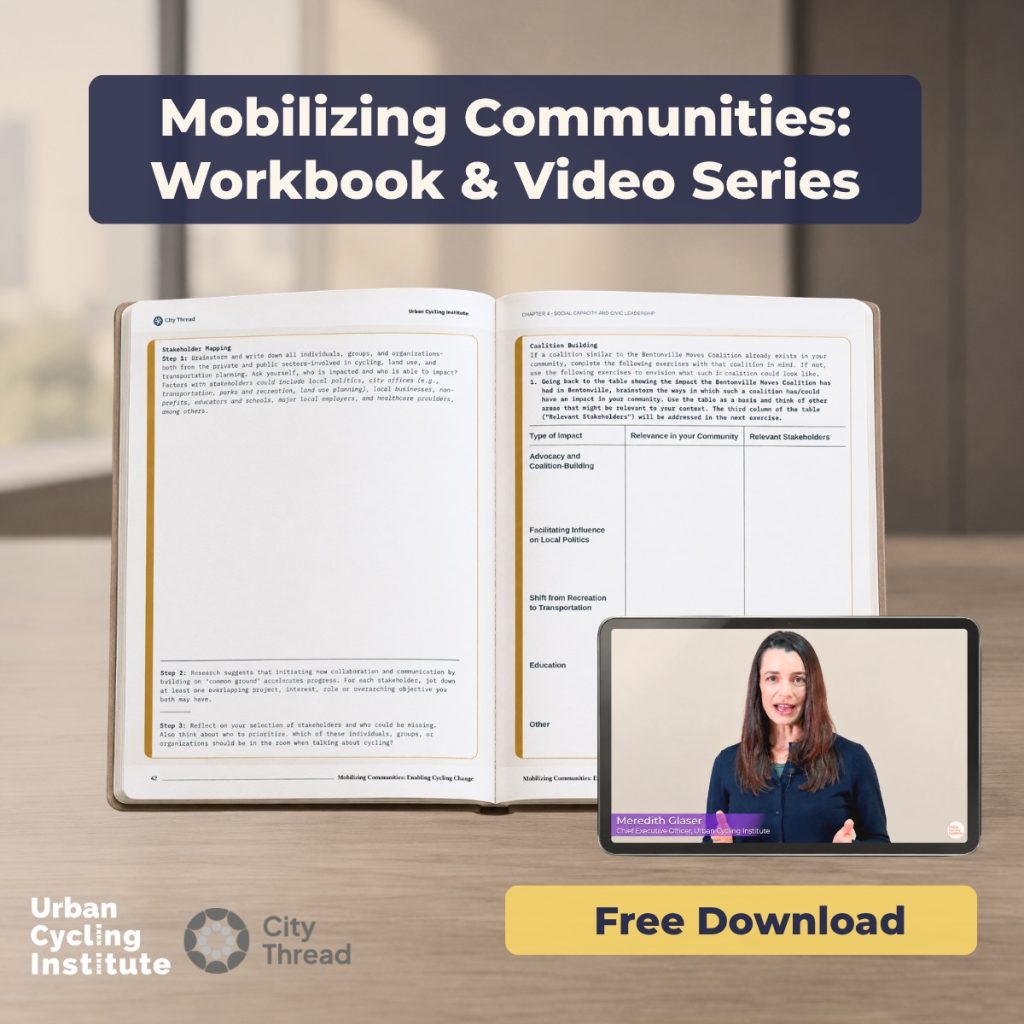
Welcome! Here is your full access to the Workbook & Video Series.
Thank you for joining our community of active mobility professionals. Below you will find all the resources to understand and act on accelerating cycling capacity in your city, region or projects.
The Bentonville Case: Mechanics of Urban Change
In 2024, the Urban Cycling Institute and City Thread launched a critical-constructive social science investigation to understand the exact mechanisms through which cities build local capacity for cycling development. Bentonville, Arkansas served as the ideal learning ground.
“Bentonville Moves is an active mobility coalition and our mission is to make the City of Bentonville the safest and most connected city for the people who drive, walk, and ride their bikes. Important differentiation here–we are not a cycling coalition or advocacy group, we’re an infrastructure advocacy group. So we are working with stakeholders and the local government to provide safe, reliable networks for our community to navigate our city on a bike, or in a car, or by foot.”
Jessica Pearson
How to use the Workbook in your projects:
- Understand the context: Use the interactive exercises and systems-mapping templates to identify where the governance bottlenecks lie in your municipality.
- Watch the 5-part video series: Complement each section of the book with short video lessons produced by our researchers.
- Target your leverage points and Build your action plan: Focus your team’s time and energy on the exact governance or capacity gaps holding your active mobility projects back
Episode 1: Introduction
Mobilizing Communities: Where Cycling Change Begins
Building a cycling city takes more than painting bike lanes; it requires shifting how a place moves, thinks, and works. This episode introduces our 2024 research in Bentonville, Arkansas—a mountain biking hub now adopting cycling for everyday transport. Learn how our workbook and video series can build momentum in your community.
Episode 2: Local Capacity and Systems Approach
No Silver Bullets: Thinking in Systems for Cycling
Think of city cycling capacity like a bike: pedals, gears, frame, handlebars, and chain must work together. This episode introduces the five capacity dimensions and explains why cycling is a complex systems problem without silver bullets. Learn to build your own systems map, a tool you will revisit throughout this entire series.
Episode 3: Institutional and Political Capacity
Who Steers? Politics, Plans and Power in Cycling
Institutional capacity is the frame holding cycling efforts together; political capacity is the handlebars steering them. This episode explores how plans, policies, political will, and intergovernmental ties drive or hinder cycling. Discover why recreational trails do not automatically create street support, and pinpoint the exact pain points in your city.
Episode 4: Technical and Financial Capacity
Pedals & Gears: Powering Cycling with Skills and Funding
Funding powers cycling projects forward, and technical know-how helps them adapt to local conditions. This episode covers the skills, data, grant writing and funding streams needed to get plans off the shelf and onto the street. Learn from Bentonville’s experience and map the barriers and enablers in your own context.
Episode 5: Social Capacity and Civic Leadership
The Chain That Connects: Driving Cycling Change
Social capacity is the chain that links people together and keeps cycling efforts moving. This episode explores how the Bentonville Moves Coalition built civic leadership, gave residents more influence in local politics and shifted cycling from leisure towards everyday transport. Map your stakeholders, find common ground and think about how to frame a coalition that works in your community.